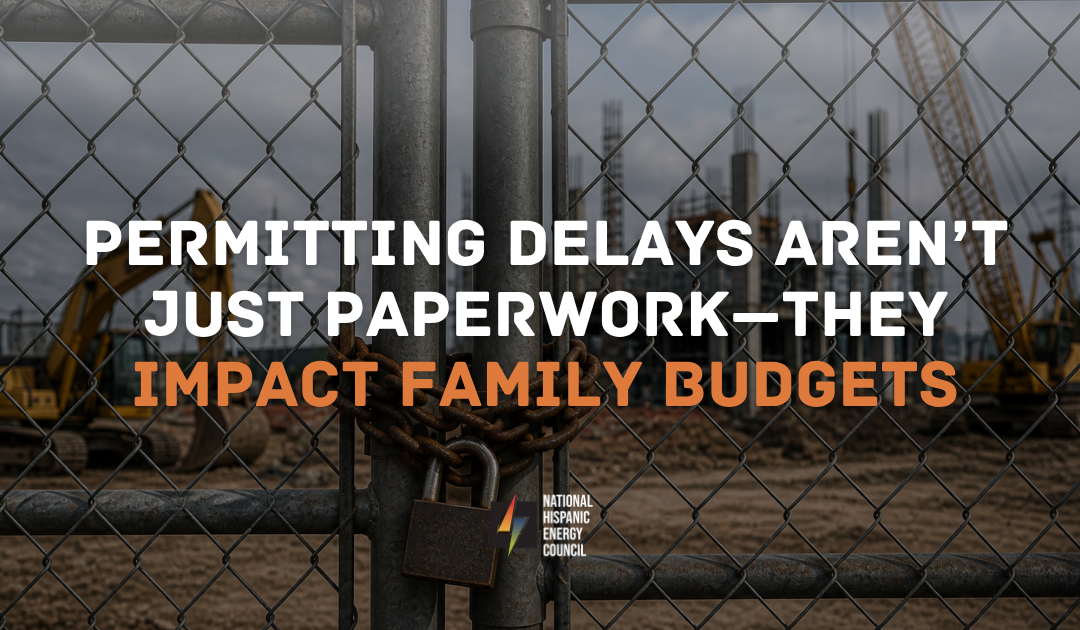
Whether the news is about the delay of a power plant, pipeline, transmission line, or a carbon capture project, it does not stay a permitting story for long. It becomes a cost story. It becomes a reliability story. And for many Hispanic families, it becomes a kitchen table story about what still fits in the monthly budget.
Hispanic households already pay 24 percent more for energy than the median American family. On top of that, Hispanic households spend almost eight percent of their income on combined home and transportation costs. That is about 42 percent above the national average. What the news does not cover, is that any delay in an energy project’s timeline can have severe consequences to a family’s finances. This is especially important to a Hispanic household, who is likely already facing a disproportionate energy cost burden—making affordable, reliable energy not just an economic issue but an equity issue.
When Delays Raise Everyday Costs
Permitting reform is not about making projects magically inexpensive. It is about making decisions more predictable, less duplicative and less likely to drag on for years. When major projects sit in review for too long, the costs do not disappear. In fact, they increase.
Financing costs rise. Materials cost more. Construction schedules slip. And the energy infrastructure that families and businesses need takes longer to come online.
That occurs whether the project is tied to natural gas, advanced nuclear, carbon capture, transmission, etc. These projects may all serve different purposes, but they have one thing in common. If they are stuck in limbo, communities wait longer for the infrastructure needed to keep energy affordable and dependable. Federal data shows that for final environmental impact statements issued in 2024, the median time from notice of intent to final statement was 2.2 years, and only about 41 percent were completed within two years.
What That Means for Hispanic Families
For Hispanic households, long delays can hit in more than one way:
- New supply and infrastructure take longer to reach the market, which can add pressure to already high household energy bills.
- Grid upgrades take longer too, which can leave communities more exposed during heat waves, cold snaps or periods of high demand.
- Job opportunities tied to construction, operations and maintenance are pushed back for workers who are ready now.
That is especially important for families already balancing rent, groceries, childcare and transportation. For them, energy policy is not abstract. It is part of the same monthly math as every other essential bill. That framing is central to NHEC’s message, which emphasizes that many Hispanic families, entrepreneurs, workers and small businesses feel energy cost pressure first and hardest.
Why Reliability Matters Too
Permitting delays are not just a cost issue. They are also a reliability issue. The Federal Energy Regulatory Commission (FERC) said in its 2025 Summer Assessment that reserve margins are getting tighter as load rises and generation retires. Correspondingly, North American Electric Reliability Corporation (NERC) reported that transmission development continues to be affected by siting and permitting challenges, with 68 projects totaling 1,230 miles of transmission delayed for those reasons. NERC has also urged regulators and policymakers to streamline siting and permitting to remove barriers to resource and transmission development.
For Hispanic families, reliability matters in very real ways. It means air conditioning during extreme summer heat. It means ensuring medical devices are running for our loved ones in need. It means keepingoursmall businesses open. In communities already carrying a higher energy burden, unreliable service is not just frustrating. It is simultaneously dangerous and expensive for our families.
A Faster Process Can Mean More Opportunity
Permitting reform also matters as delayed projects also mean delayed jobs. Hispanic and Latino workers make up 18 percent of the U.S. energy workforce, and they held 31 percent of all new energy jobs created in 2023.
Those are not small numbers. They show that Hispanic workers are already instrumental in helping build America’s energy future. When projects move from paperwork to construction, they create opportunities for electricians, welders, equipment operators, technicians and other skilled workers who keep energy infrastructure running.
Streamlining Should Not Mean Cutting Corners
None of this means community protections should be ignored. Streamlining means clearer timelines, better coordination between agencies and fewer unnecessary delays. It does not mean weaker environmental standards or shutting communities out of the process.
For Hispanic families, permitting reform is not just a Washington process issue. It is about whether energy policy reflects real life. When projects are delayed for too long, families can end up paying more, waiting for reliability improvements and missing out on job opportunities. A better process will not solve every energy challenge overnight, but for households already carrying a heavier burden, it is one practical place to start.
